
Meta Ads
Meta Ads Creative Strategy 2027: A Testing System
18 September 2026 · 14 min read · By Orion Media Group
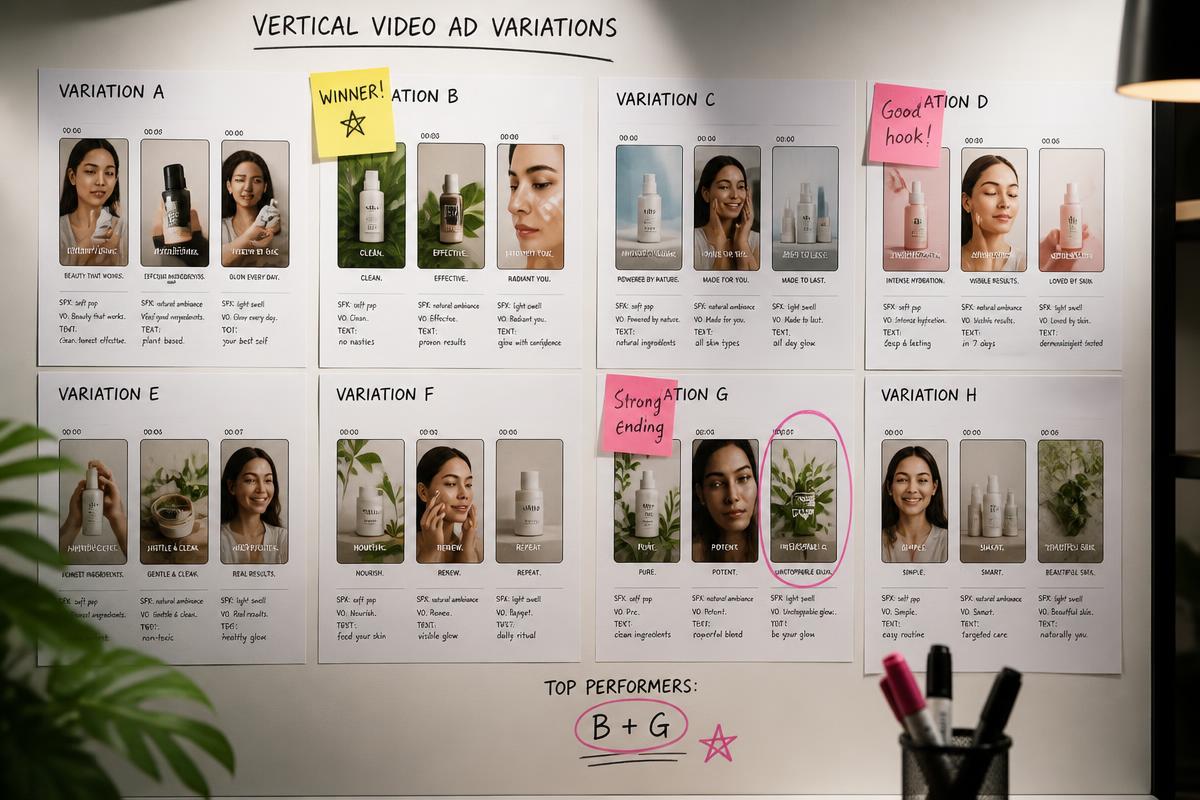
Meta continues to automate delivery decisions that advertisers once controlled manually. That does not make strategy less important; it moves more of the controllable advantage into the offer, the message, the evidence and the creative supply system.
A 2027 creative strategy should not depend on guessing which editing trend will be popular. It should give the account a steady flow of genuinely different ideas, enough structure to learn from results and a fast route from a winning message to fresh executions.
This guide is an operating model, not a promise of performance. Platform delivery, market conditions, landing pages and the offer itself all affect outcomes.
1. Start with customer tensions, not ad formats
A format describes how the message appears; an angle explains why the buyer should care. Before choosing testimonial, founder, demo or comparison, list the tensions visible in customer interviews, reviews, support conversations and sales calls.
Good angles are meaningfully different. Convenience, risk reduction, identity, speed and proof are separate reasons to act. Changing the caption colour while keeping the same reason is not a new test.
- Mine sales calls for repeated objections.
- Use customer wording rather than internal product language.
- Write one testable proposition per concept.
2. Build a portfolio of creative jobs
An account needs creative that does different jobs: introduce the problem, demonstrate the product, answer an objection, provide social proof and make the offer clear. A library made entirely of testimonials or founder videos becomes narrow even when each execution looks different.
Map each asset to awareness state and intended response. This makes the brief more precise and prevents a top-of-funnel explainer from being judged by the same early metric as a direct-response retargeting ad.
- Problem recognition.
- Mechanism or product demonstration.
- Objection handling.
- Proof and credibility.
- Offer and action.
3. Produce modularly without producing generic ads
Record hooks, bodies, proof moments and calls to action as separable pieces. Modular production lets editors create several coherent combinations without asking the presenter to repeat the entire script for every variation.
The constraint is narrative coherence. A hook about one pain point cannot be attached to a body proving something else. Keep every module inside one angle and use variations to test how that angle is introduced or evidenced.
4. Diagnose the part that failed
Do not label every weak result 'bad creative.' Low early retention suggests the opening did not earn attention. Adequate attention with weak click response suggests the proposition or transition. Clicks without conversion point toward message match, offer, page experience or audience quality.
Use account-relative baselines rather than universal benchmark screenshots. Results vary by market, placement, objective and attribution settings; the most useful comparison is often against your own recent creative serving the same business goal.
- Opening: first-frame clarity and early retention.
- Message: click response and qualified engagement.
- Destination: conversion rate and message match.
- Economics: acquisition cost, contribution and customer quality.
5. Treat fatigue as a pipeline warning
Fatigue is not a fixed number of days. Watch the relationship between frequency, delivery, response and conversion cost. When the same asset reaches more of the same audience and response deteriorates, the production system should already have replacements ready.
Do not discard the learning inside a winner. Carry the proven angle into a new creator, setting, demonstration or proof point while preserving the reason it resonated.
Media Strategy Lab can run the creative pipeline and Meta campaigns together, so account learning becomes the next production brief instead of a delayed report.
Book a call6. Connect organic and paid learning
Organic content can reveal language, stories and presenters that hold attention before paid testing. Paid campaigns can then provide cleaner comparisons between propositions and feed those lessons back into the editorial calendar.
The two channels should share a learning library, not necessarily identical files. An organic post may need more context and community interaction; a paid version may need the product and action earlier.
7. The 2027 review rhythm
Run a weekly creative review focused on decisions, not dashboards. Record what launched, what signal changed, what hypothesis remains plausible and what should be filmed or edited next.
At monthly level, examine creative diversity, production speed, customer quality and whether the account has become dependent on one message or presenter. Resilience is the ability to replace a tiring winner without starting strategy from zero.
- Weekly: launch, diagnose and document.
- Fortnightly: produce iterations of proven angles.
- Monthly: audit diversity and downstream customer quality.
If your Meta account needs more than another isolated batch of ads, contact Media Strategy Lab. We build the strategy, creator briefs, edits, tests and reporting as one system.
Book a callFrequently asked questions
- What is the most important Meta Ads trend for 2027?
- Creative operations are becoming more important as delivery automates. Brands need a reliable system for producing distinct, evidence-led concepts and learning from results.
- How many Meta ad creatives should a business test?
- There is no universal number. The right volume depends on spend, audience size and fatigue rate; test fewer distinct hypotheses properly rather than starving a large batch of cosmetic variations.
- How do you know if Meta ad creative is fatigued?
- Look for deterioration in response and conversion cost as frequency rises, compared with the account’s own recent baseline. Confirm that seasonality, offer changes and landing-page issues are not the real cause.
- Should Meta ads look like UGC?
- UGC-style creative is useful for many offers, but it is one format rather than a complete strategy. Demonstrations, founder explanations, statics and polished proof assets can all have a role.
- Can organic posts become Meta ads?
- Yes. Organic response can identify promising language and stories, but the paid version may need a clearer proposition, earlier product context and a placement-specific call to action.